
Data archive
Overview
Section titled “Overview”The data archive component and architecture is meant to provide a way to maintain database performance, while retaining data in a long-term storage solution. Importantly, Scouter focuses on providing real-time monitoring capabilities and alerting. And while most of this relies on having short-term data (defined as 60 days), there are some use cases where a user may want to visualize or audit data from longer periods of time. This component is meant to provide a way to do that.
TLDR: Scouter deletes records older than the configured retention period (default: 30 days) in order to maintain database performance, so we need a retention strategy for expired data in the event a user needs access to it.
How it works
Section titled “How it works”ScouterServerConfig will now load a default ObjectStorageSettings struct on startup. This struct serves as a configuration for the object storage provider.
pub struct ObjectStorageSettings { pub storage_uri: String, pub storage_type: StorageType, pub region: String, // this is aws specific}Accepted environment variables are:
-
SCOUTER_STORAGE_URI: The URI for the object storage provider. This must be one of the following:s3://<bucket-name>for AWS S3gs://<bucket-name>for Google Cloud Storageaz://<container-name>for Azure Blob Storage./scouter-storagefor local storage (default if not set)
-
AWS_REGION: The AWS region for the object storage provider. This is only required if theSCOUTER_STORAGE_URIis set tos3://<bucket-name>. It defaults tous-east-1if not set.
In addition to ObjectStorageSettings, DatabaseSettings now takes on an additional environment variable DATA_RETENTION_PERIOD which indicates how long data should be retained in the database before moving it to long-term storage. Note this is only for copying data to long-term storage. The actual deletion of data is still handled by pgCron. The default value is 30 days.
Component Architecture
Section titled “Component Architecture”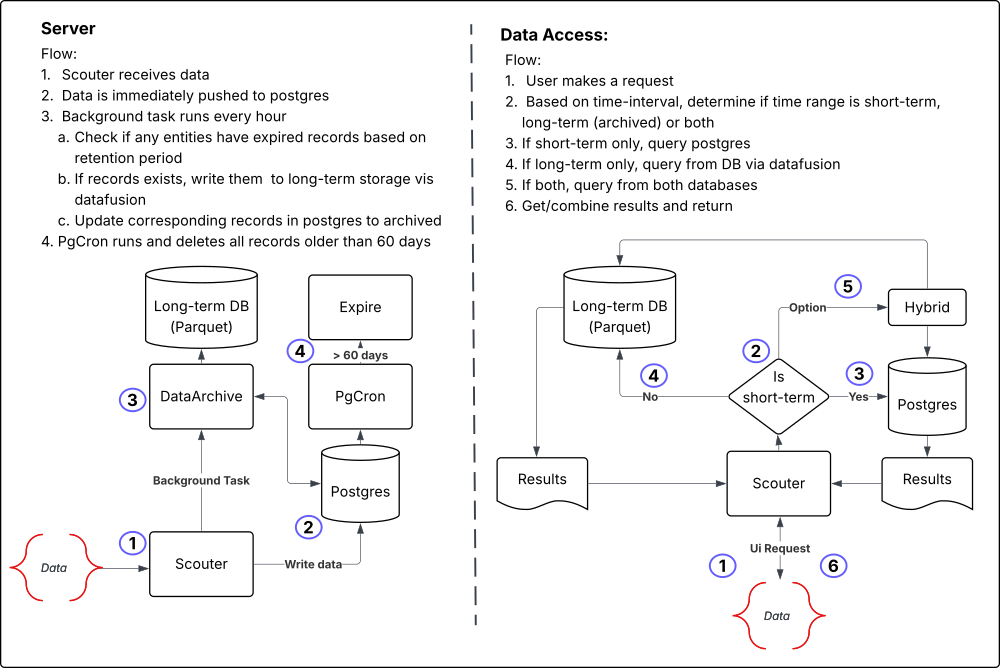
Implementation Details
Section titled “Implementation Details”The data archive component itself is comprised of a few key parts:
- Scouter Dataframe: This is a crate that defines the arrow datafusion, parquet and object store interfaces for reading and writing data to an from long-term storage. It also contains drift-specific logic that is implement via traits.
Primary Interface
Section titled “Primary Interface”pub enum ParquetDataFrame { CustomMetric(CustomMetricDataFrame), Psi(PsiDataFrame), Spc(SpcDataFrame),}The ParquetDataFrame enum is the primary interface for the data archive component. It allows for different types of data frames to be handled in a uniform way. Each variant of the enum corresponds to a specific type of data frame, such as CustomMetric, Psi, or Spc.
It’s primary methods for reading and writing data are:
pub async fn write_parquet( &self, rpath: &str, records: ServerRecords,) -> Result<(), DataFrameError>pub async fn get_binned_metrics( &self, path: &str, bin: &f64, start_time: &DateTime<Utc>, end_time: &DateTime<Utc>, space: &str, name: &str, version: &str,) -> Result<DataFrame, DataFrameError>- Scouter Server DataArchiver: Upon startup, the Scouter server will create a
DataArchiverinstance and start a background worker that will run every hour. This worker will check for any expired data in the database and move it to long-term storage. TheDataArchiverwill use theParquetDataFrameinterface to read and write data.
pub async fn setup_background_data_archive_workers( db_pool: &Pool<Postgres>, config: &Arc<ScouterServerConfig>, shutdown_rx: tokio::sync::watch::Receiver<()>,) -> AnyhowResult<()> { DataArchiver::start_workers(db_pool, shutdown_rx, config).await?; info!("✅ Started data archive workers"); Ok(())}The primary method for the background worker is archive_expired_data, which will check for any expired data in the database and move it to long-term storage. It iterates over each drift type and processes records according to their trait implementations.
pub async fn archive_old_data( db_pool: &Pool<Postgres>, config: &Arc<ScouterServerConfig>,) -> Result<ArchiveRecord, ServerError>async fn process_record_type( db_pool: &Pool<Postgres>, record_type: &RecordType, config: &Arc<ScouterServerConfig>,) -> Result<bool, ServerError>async fn get_entities_to_archive( db_pool: &Pool<Postgres>, record_type: &RecordType, retention_period: &i32,) -> Result<Vec<Entity>, ServerError>async fn get_data_to_archive( tx: &mut Transaction<'_, Postgres>, record_type: &RecordType, entity: &Entity,) -> Result<ServerRecords, ServerError>async fn update_entities_to_archived( tx: &mut Transaction<'_, Postgres>, record_type: &RecordType, entity: &Entity,) -> Result<(), ServerError>`Dependencies
Section titled “Dependencies”- Primary External Crates
arrow-arraydatafusionobject_storeparquet
Performance Considerations
Section titled “Performance Considerations”- Asynchronous Processing
- Non-blocking
- Async database operations
Version: 1.0 Last Updated: 2025-04-23 Component Owner: Steven Forrester